Monday, January 02, 2006

We Have Shopping so You Have Something to Do on Your Visit

I just got the Official Springfield 2006 Visitors (sic) Guide.

Although I long ago accepted that huge factions of America were so enamored with shopping that they considered it the primary raison d'etre and that tourist bureaus would play along like everyone else, I was not prepared for the term "Shopportunities." But there it was tucked in the guide on page 39 right after Off-Track Betting and Skating. (Go figure on their alphabetization.)

No doubt the term will be sprouting up soon at a media outlet near you. Yuck. At least you've been warned.

Sunday, January 01, 2006

Globalism, Authenticity, Preservation and Culture: Appiah's Case for "Contamination"

If you read one article this weekend, make it Kwame Anthony Appiah's "The Case for Contamination" in today's New York Times Magazine.

The subtitle is, "No to purity. No to tribalism. No to cultural protectionism. Toward a new cosmopolitanism." I found it provocative and deeply insightful. Here's a sample quote:

"So the time of the successful(Ghanaian) farming family is passing, and those who were settled in that way of life are as sad to see it go as American family farmers are whose lands are accumulated by giant agribusinesses. We can sympathize with them. But we cannot force thier children to stay in the name of protecting their authentic culture, and we cannot afford to subsidize indefinitely thousands of distinct islands of homogeneity that no longer make economic sense.

Nor should we want to. Human variety matters, cosmopolitans think, because people are entitled to options. . . .

Talk of cultural imperialism 'structuring the consciousnesses' of those in the periphery treats people like . . . blanks slates on which global capitalism's moving finger writes its message, leaving behind another cultural automaton as it moves on. It is deeply condescending. And it isn't true."
The entire piece is an excerpt from his forthcoming book Cosmpolitanism: Ethics in a World of Strangers.

Wish you Were Here: The Curt Teich Postcard Archives


The Curt Teich Postcard Archives
housed at the Lake County Discovery Museum in northern Illinois seems to be one of those happy convergences of documentation, history, place and manufacturing.

Here's a brief history of the Curt Teich company pulled from the museum's website:

The core collection in the Teich Archives, acquired by the Lake County Discovery Museum in 1982, is the industrial archives of the Curt Teich Company of Chicago,which operated from 1898 to 1978 as the world's largest printer of view and advertising postcards. The Company was founded by Curt Otto Teich (1877 - 1974),who immigrated to the United States from Lobenstein, Germany in 1896.

The Teich Company saved examples of every image printed, as well as company records and the original production materials for each card.

The core collection consists of over 360,000 cataloged images, 1898 to 1978, relating to 10,000 towns and cities primarily in the United States and Canada, and more than 87 other foreign countries.


The images range from bucolic countrysides to banal industrial shots to retro-y promotional materials like the one above of the "Admiral Oasis Auto Hotel" in Morton Grove, IL.

The archive's digital site, which features about 16,000 images, is a bit clunky and frustrating to search. It's part of a greater online archive of northern Illinois historical material called Digital Past.

If you're even a little bit of a history buff, it's fun to dig around in.

Friday, December 30, 2005

Ambler Theater, PA: Fix up the Movie House and the Town will Follow

I've been in the northwest suburbs of Philly this week visiting my folks. Last night we wandered down to the Ambler Theater to see The Squid and the Whale (intensely dark, can't say I recommend it), but also to see the newly renovated movie house.

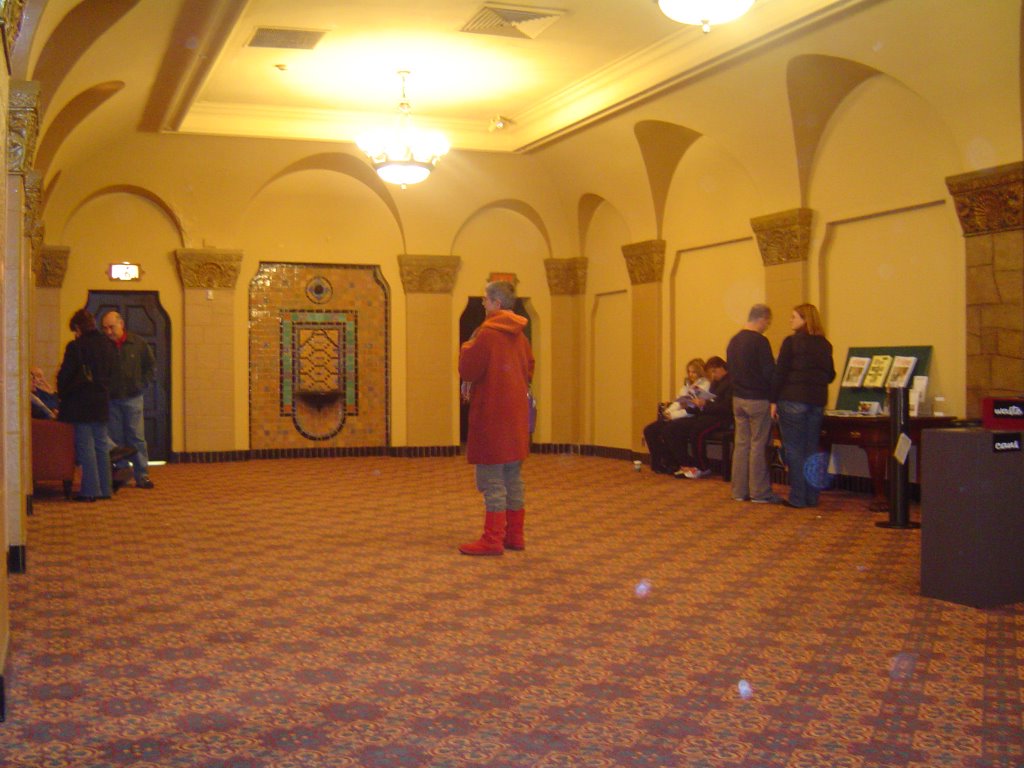
Originally built in 1928 and designed by architect Solomon Kaplan, it's unclear when the Ambler Theater closed and how long it sat idle before a group of folks bought it, renovated it and began running it as a non-profit community film center in 2003. They now show independent films, feature kid's Saturday matinees and host guest lecturers. I also like that the concession stand sells locally-made Asher's Snow Caps along side the mainstream brand.
The area around the movie house, which had once been a string of empty storefronts is now a thriving strip of restaurants, bars, offices, and shops.While they have plans for a second phase of renovation, the first phase has been completed, which included redoing the lobby, refurbishing two theaters, and hanging the lovely neon sign out front.

While putting this post together, I ran across Cinema Treasures: Discover, Preserve, Protect, a five-year old website dedicated to "movie theater preservation and awareness."

Here
is what they've posted about the Ambler Theater, but you'll note the commenters hack away at the accuracy of their listing.

Cinema Treasures logs more than 11,000 theaters in the U.S. and around the world, including those that have been demolished. Accuracy flaws aside, it's good to see someone trying to ensure this wonderful part of our cultural history doesn't go overlooked.

Hopefully they'll figure out a system for getting their facts straight. Seems like they might be victims of their own success in choosing a cause that so many people share so passionately with them. But, they owe it to themselves and their love of theaters to get it right. Successful awareness-building and preservation efforts need a rock-solid foundation. And, the Ambler Theater's resurgence shows off just how rewarding that can be.

Friday, December 23, 2005

Tree of a Christmas Past


Christmas tree in plaza of the Chicago Daily News building, 400 West Madison, 1929. Photo source is the Chicago Daily News Photo Archive.


See you after the holidays. Good will to all.

Tuesday, December 20, 2005

The Blogging Mayor of Round Lake

No kidding. That's Bill Gentes' blog's name. He's serving his second term as Round Lake's part-time mayor, and he's also a realtor and track and field afficionado.

Here's Round Lake's profile on EPodunk. It's a town of about 9,000 located about 50 miles northwest of Chicago.

Gentes's blog gives an in-the-trenches perspective of the issues facing anyone who takes on a leadership position in a relatively small town. It ain't easy.

Unfortunately, the mayor doesn't permalink his blog, so I can't share with you some of my favorite posts. You'll have to go over and scroll for yourself. (Be sure to read the post and comments about the new squad car design.)

Monday, December 19, 2005

Out of Illinois: Poet Gwendolyn Brooks

The great poet and Chicagoan Gwendolyn Brooks was born in 1917 and died in 2000. She served as Illinois's Poet Laureate, was the first African American to win a Pulitzer Prize, and earned a host of other honors.

Below is her poem A Penitent Considers Another Coming of Mary, For Reverand Theodore Richardson. It reminds me of Christmas and our country's arc of conduct lately. [For those of you of other faiths, welcome and please bear with me.]


If Mary came would Mary
Forgive, as Mothers may,
And sad and second Saviour
Furnish us today?

She would not shake her head and leave
This military air,
But ratify a modern hay,
And put her Baby there.

Mary would not punish men--
If Mary came again.


Brooks' Bean Eaters (my all time favorite Gwendolyn poem) can be found here. An audio file of her reading We Real Cool can be found here.

Link to Elegy for Gwendolyn Brooks by Quraysh Lansana.

Modern American Poetry site on Brooks here.

Link to the Gwendolyn Brooks Elementary School in Aurora, IL that sadly does little on their site to honor her.

Gwendolyn Brooks Center at Chicago State University here.

First Peek at the World: Bertrand Goldberg's Prentice Women's Hospital

My nephew, Luca Michael, arrived on the planet this week. He had been journeying here for a while. I mean for much longer than nine months.

I know this because my sister-in-law said years ago, after her second daughter was born, that she had a strong feeling someone else should be sitting around her kitchen table. She just couldn't shake it. And, now -- abracadabra -- he's here just in time to wrap and put under the tree.

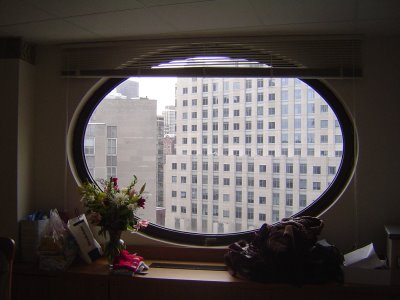
The photo above is a view from Julianna's recovery room at the Prentice Women's Hospital at Northwestern Memorial. It was designed in the 50s by Bertrand Goldberg, the same guy behind the Marina City Towers and the River City complex. A new women's hospital is in progressand due to open in 2007.

Both of my children were born here, too. The rooms are remarkably tranquil and the odd-shaped window (just one per room) seemed rightly suited to the mind-boggling logistics of childbirth and the intense morphing our lives had just gone through. I liked how my children's first view of the world was like looking out of a fishbowl. When we held them up to the outside world, the ovals seemed to curb the expanse of it, to make it palpable but unintimidating to such tiny souls. No way these windows would keep day-olds from turning back on their tender journeys.


I asked one of my sister-in-law's nurses this week about what would happen to the building when the new hospital opened. They're not tearing it down she said. They're using it to expand the psych ward.

Photo of Prentice Women's Hospital courtesy of ArchiTech Gallery.

Sunday, December 18, 2005

Why I'm Baking and Blogging

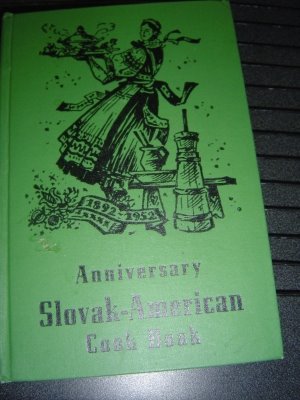
I'm up late tonight protecting the shredded thread that connects me to my maternal great-grandparents who immigrated here from Slovakia. In other words, I'm making bobalky. (Pronunced buh-bye-kee.)

Slovaks (or, at least Slovak-Americans as far as I know) eat bobalky on Christmas Eve with courses of fish and mushroom soup. Bobalky are little tiny rolls that are air dried (for best results, I've found) until they're very hard. Then, they're dropped into boiling water for about five minutes and drained like pasta. We roll them in lots of browned butter and serve them with sauerkraut or, worse, poppy seeds.

My husband, whose ethnic heritage is Greek and Italian (also several generations removed), describes bobalky to his friends as "the boiled bread dish." But, to his credit, he eats it heartily. (Although, come to think of it, he eats everything heartily.) I, of course, love it. It's The Ultimate Comfort Food.

I can't quit making it. No bobalky = no ties to family history or Eastern Europeanism. Bobalky are the only thing I have left that make me a dash ethnic. The kitchen smells like my grandmother's did. The fragrant melange of sauerkraut, boiling dough, and stainless steel whisk me back to their Pittsburgh steelworker's home and makes me want to rummage in their freezer for Klondikes.


Without bobalky, I'm no longer ethnic. When we drop those links to our ancestral heritage -- or, when they erode, we become more about the place where we live. I think. That's what's mainly left. Who is part of our community. What kind of structure to we live in. What kind of groceries do we buy (or grow) and what food do we eat. The culture we have access to. What our streets look like. Where we can drive in our car within a day. Where we worship or not.

Really, what else is there if you as are many generations removed as I am from your ancestral homeland? Fourth of July Parades? The Tonight Show? Casseroles? Jazz?

I think this is why I hold onto bobalky. So I can avoid the tough questions about just what my culture is when the ethnic customs have been whittled away.

Boiled bread anyone?

Thursday, December 15, 2005

Wright's Usonian Houses Featured on About.com


About.com features a brief summary with lots of links to coverage of Frank Lloyd Wright's Usonian Houses.

The author, Jackie Craven, includes photos of the Zimmerman home (pictured above)in Manchester, New Hampshire as well as others.

Monday, December 12, 2005

Commute


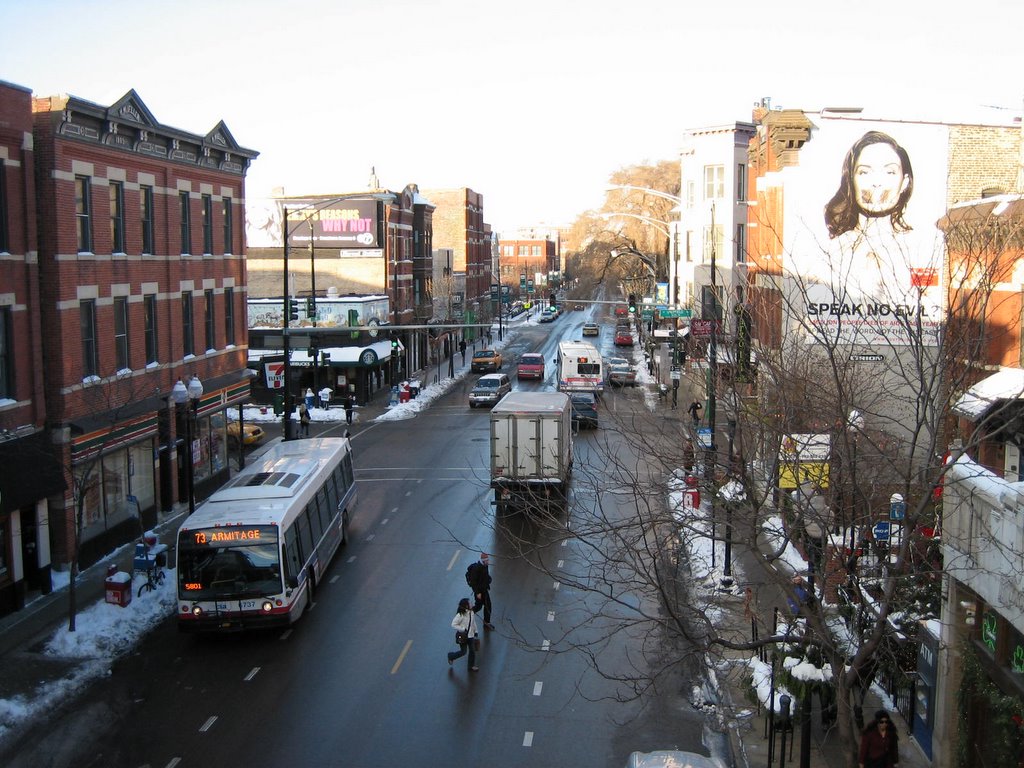
A view of Armitage & Sheffield via News and Analysis blogger Nathan Kaufman. I found his blog by "riding the red line" through my neighborhood on ChicagoBloggers.com

Politics as Refreshing as, Oh, Let's Say a Cool Glass of Clean Water

From the Office of Water Reclamation candidate and conservationist Debra Shore (earlier posts here and here):

"I am excited to announce that this morning I filed my petitions as a candidate for the board of the Metropolitan Water Reclamation District of Greater Chicago. We had more than 20,000 signatures gathered by hundreds of volunteers from all reaches of Cook County. . . .

20,000 signatures sends a powerful message, but it’s not about me. It’s about you – you and the thousands more in our county who believe that government can and should be of the people, by the people and for the people. It’s about protecting our precious natural resources, about bringing fresh ideas to the Water Reclamation District, about integrity and accountability in government. And it’s about our collective vision of supporting a sound economy and a sound ecology. "

Friday, December 09, 2005

Exploring Abe: Gettysburg PowerPoint

It's been way too long since I've updated my Abraham Lincoln shtick series formally titled Exploring Abe. (Pick up thread here.)

Here's some great fun at the great man's expense: his Gettsyburg Address as a Power Point presentation. [Example bullet point: Hallow (in narrow sense)]


Image courtesy of ClipartHeaven.com

Loopy about Looper

I am such a big fan of my fellow Chicago blogger Looper's site. Lush, reach-out-and-touch photography of the place where we live. You can't beat it. Here's a lovely post where he discovers a new scaffolding being erected near Block 37 that's beginning to look a lot like Christo's The Gates in NYC.

I was going to poach one of his photos and post it here, but he works in an essay fashion and while each photo is strong on its own, they're at their best when seen with their compatriots. So rather than out-of-contextualize one of his pieces, I would prefer to insist that you go visit him over there.

Thursday, December 08, 2005

WWMD?


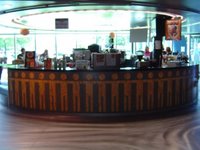
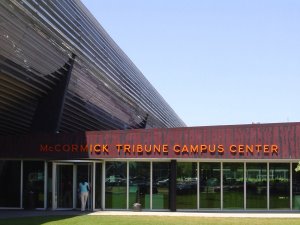
You can't read it in this photo, but someone scribbled "Use double paned windows. Hah." under this sign at the coffee shop in IIT's McCormick Tribune Campus Center. The Mies Society is selling "WWMD" bracelets to help raise funds for the restoration of Crown Hall.

If you can decipher the meaning behind the lampoon, please let the rest of us in on it by leaving a comment. (My guess is that the open, airy Crown Hall, which houses a main work area of the school of architecture, is freezing on days like today. Perhaps a chilled student let loose.)

Monday, December 05, 2005

Lord God Bird Followers Make "The Social Page"

Nice write-up today on "The Social Page" of the Trib about a "conservation" soiree at the Field Museum. More than 500 people turned out on a Sunday night to celebrate Gene Sparling's discovery of the ivory-billed woodpecker.

You'll recall he found the thought-to-be-extinct "Lord God" bird alive and well and living in Arkansas earlier this year. Sparling was the evening's keynote speaker and the Trib ran the story under the headline, "Birders flock to meet rock star of the conservation world."

Although reporter Lucinda Hahn did a lame job of convincing me she really did get "bird fever," she honed in on some lovely quotes about the excitement surrounding this bird's find, including this one:

"The bird provides a symbol of conservation opportunity in front of us," said (Director of the Cornell Lab of Orinthology John) Fitzpatrick, referring to the decades of effort that restored the woodpeckers' Big Woods habitat, "instead of just the symbol of conservation destruction we had for 10 years."


Photo courtesy of Blue Dog Tours.

Sunday, December 04, 2005

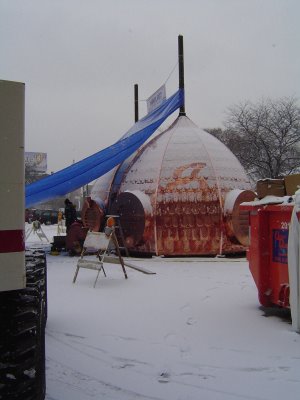
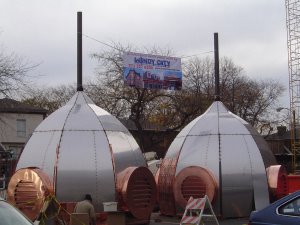
Snow Domes, Take 3


I just can't get enough of these cupolas. It's not every day you can just mosey by and watch something like these being made. Please bear with me while I photograph their progress again and again.

The Tree of Where We've Been

I'd say it was two days after Thanksgiving when the folksy hay bales and hand-picked pumpkins I'd put out on our front stoop poofed into something preposterous. By this past Saturday, when they were blanketed with snow and the Santa-Jesus thinking was kicking in everywhere, I worried the neighbors would complain. I stuffed all three bales and two pumpkins into my garbage cans to await Tuesday's pick up. My son, outraged at the disposal of Halloween, carted a third pumpkin up to his bedroom for safe keeping.

In the meantime, the Christmas tree went up. Here are two tips for you: 1) When stringing lights, the plug end, with the prongs, should be the end that moves down the tree, around and around and around, to the outlet. Not vice versa. Trust me. You'll save yourself an hour of frustration and your child impatiently gazing at you like you're totally lame.

2) Whenever you travel, buy a Christmas ornament, no matter where you go or how meaningless of a trip it might seem. When holiday trimming time comes, you'll be transported to the memories of a tiny, crowded gift store down a forgotten side alley in Venice or a dopey trip to Judy Garland's birthplace or one of many trips to see mom and dad in Philadelphia. It's a wonderful joy to rediscover where you've been and how richly it can be remembered when you have a little token of that place in your hands.

Looking out For All the Open Spaces: The Openlands Project

"Openlands Project, founded in 1963, is an independent, non-profit organization dedicated to preserving and enhancing public open space in northeastern Illinois."

Sunday, November 27, 2005

Back Issues: Paste


I had some catching up to do, so I took a stack of magazines with me over T-giving weekend. While WXRT's Lin Brehmer does a heckuva lot to keep Steve Goodman's memory alive in Chicago, it was still a treat to see the Georgia-based Paste Magazine dedicate an entire back page (in the June/July issue) to the musician who called this town home:

(Steve) Goodman, a terrific singer and even better songwriter who lived for the Chicago Cubs and died far too young, still might one day receive the critical and popular acclaim he deserves. You never know. . . .

Throughout his career Steve Goodman confounded listeners and critics by tossing musical changeups and curveballs into the mix. Pegged as a sensitive singer/songwriter folkie, Goodman turned around and wrote hilarious parodies of country music (the David Allan Coe-popularized "You Never Even Call Me By My Name," which skewers every cliche ever lassoed to a two-step shuffle), covered jazz standards from the '30s, and enlisted stalwart bluegrass mandolin picker Jethro Burns to be his musical foil. Pegged as a serious, literary writer, he thumbed his nose at pretension by concisely summarizing the plot of Moby Dick as a twelve-bar blues. . . . And always he wrote about his beloved Chicago, firing broadsides at the notorious Lincoln Park Towing Company, simultaneously eulogizing and sending up longtime mayor Ricahrd Daley, echoing the prayers and doubts of millions of Cubs fans worldwide.


The article was written by Andy Whitman who blogs at Razing the Bar. You can find the full text posted there.

Wednesday, November 23, 2005

From Gourd Man to You on Thanksgiving

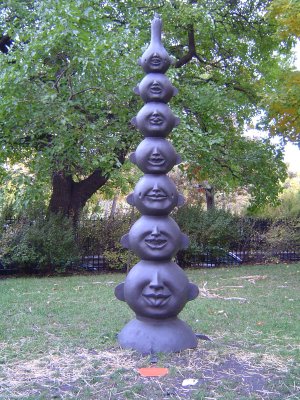
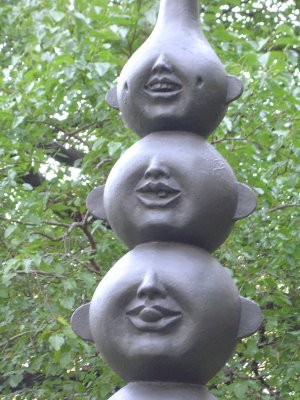
This one makes me happy. Can't help it. It's Gourd Man by Shen Cheng Xu and it's part of the Lincoln Park Contemporary Art Initiative. You can find it tucked away on the southeast corner of Dickens and Lincoln Park West.

Happy Thanksgiving. See you next week.

--jr

Monday, November 21, 2005

Rem Koolhaas, IIT, and the Absolute Absence of Women

I don't consider myself an architectural critic. I have not immersed myself in the history of buildings and starchitect personalities in order to form academic opinions. Rather, I start with the place where I live (or visit) and think about what I see and how I feel about it.

It's important to me to be informed and accurate and respectful of the efforts of architects and patrons alike, but at the end of the day, it's my skyline, my neighborhood, my vista, too. I feel from that standing alone, I have a right to comment on what's built around me, regardless of how much Vincent Scully I've read.

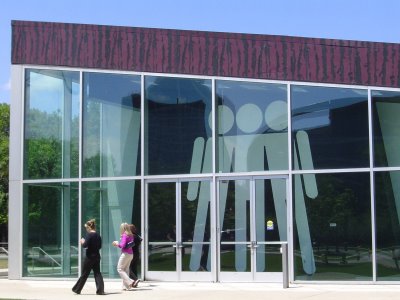
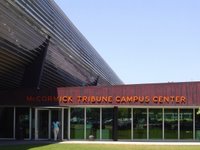
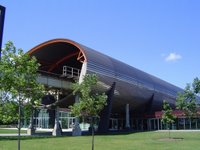
So, it wasn't until this past August that I got to the Illinois Institute of Technology to see Rem Koolhaas's campus center that was completed in 2003. While I'm working on an essay about the the building's overall merits to be published elsewhere, one aspect of Koolhaas's work really bothered me. Yet, I've found no other writer or critic who has mentioned it.

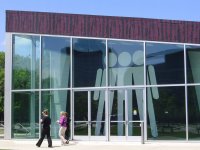
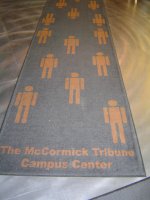
In the austere, universal graphics Koolhaas uses throughout the center, he has eliminated women. Everywhere, he's planted the universal male graphic, yet females are not represented.For a man who holds himself up as a hyper-aware globetrotter (in one of his books, he logs the staggering number of nights he's spent in hotels and the number of miles he's flown), Koolhaas doesn't seem too bothered with reflecting that insight in the information-conveying details of his work.

This interior should have been universally lampooned by IIT's female faculty and student body.It's an embarrassment to the university and its female students as far as I'm concerned.

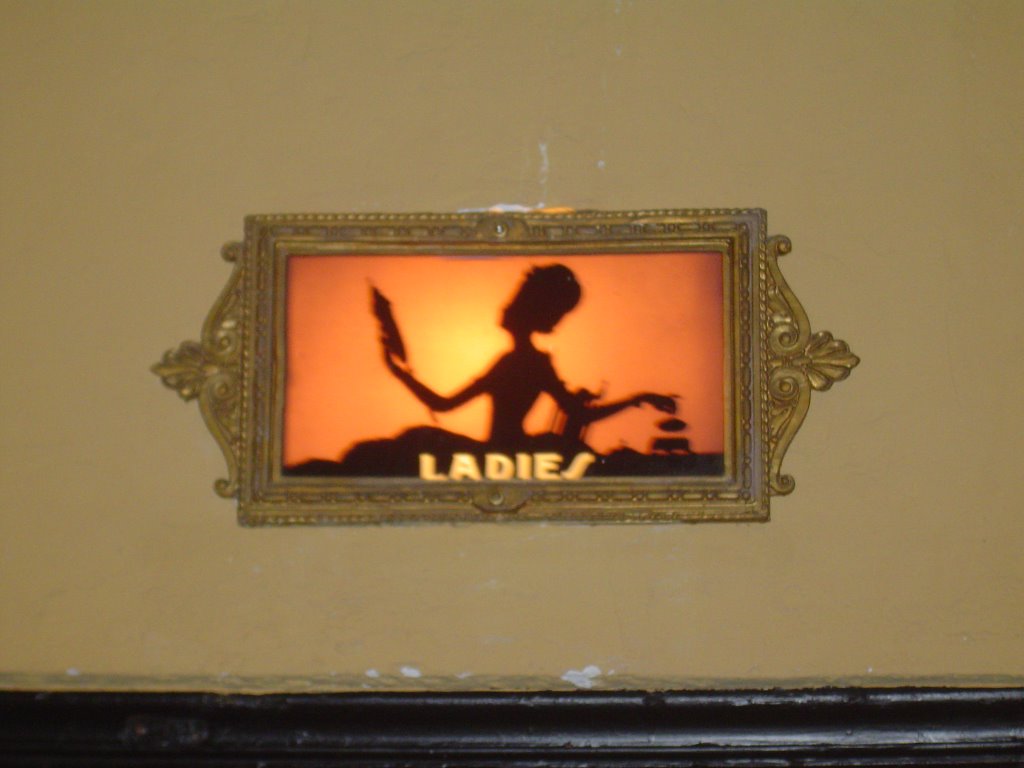
And before you suppose that I'm jumping to conclusions, that Koolhaas has used this male symbol to convey a universal sense of "mankind" and that I'm just hypersensitive, take a look at this:
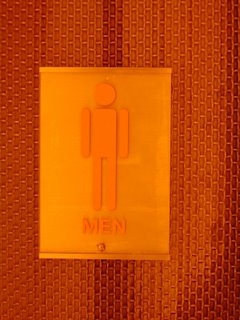
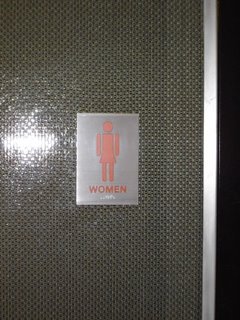


The bathroom plaques reveal the truth about who is represented in Koolhaas's graphics. Women get when we're not really included. This space depicts for us in relatively clear terms that we're not expected to belong there or thought of as belonging there. And, it's the student commons of a major university.

Why did all the critical eyes on this project allow this to pass unnoticed and unaddressed?

Update: I am grateful to a commenter for pointing out who designed the interior of this building and recommending I contact them. I will after Thanksgiving.

I believe this issue is a bit like how our consciousness has been raised in the way we write. We no longer use the pronoun “he” to represent men and women. We change the subject to a plural so we can write “their.” Or we interchange “he” and “she” to show our awareness of both genders. Surely an organization as creative as OMA and their design team could have come up with a way of creatively addressing (or rendering moot) issues of gender. There are details in buildings that convey information that can be read. This building, I still argue, got those details wrong. But, I’m looking forward to learning more.

Thank you to my commenter and to all of you who stopped by. May you find much on your plates this week for which you are thankful.

Sunday, November 20, 2005

Cupolas, Continued

Holy Trinity on Noble and Division awaits its new cupolas. See earlier post on Chicago Metroblogs here to chart progress.


Is it just me or do they look 20,000 Leagues under the Seaish?

Tuesday, November 15, 2005

Ten Years of Blue Bag Failure

"With the well-documented failure of the blue bag program, and with other cities embracing comprehensive recycling programs, if Chicago wants to keep its reputation as environmentally advanced, sooner or later we're we're going to have to do a lot better," said Vandercook.


Full story, via Community Media Workshop, here.

21st Century Landscape: Cell Phone Towers

At the turn of the last century the urban landscape featured smokestacks. We've got cell phone towers.

To be exact, according to this site, there are 117,562 cell phone towers in Chicago as of September 2005. And, once you've noticed one, you see them all.

It's like riding up the elevator with someone who's humming Yankee Doodle Dandy. You can't get the damn song out of your head three hours later. Nor can you get the cell phone towers out of your sight. They're everywhere. And, they're as ugly as Yankee Doodle Dandy is annoying.

An August 2005 Associated Press story quotes monthly payments for cell phone tower space rentals at $800 - $2000 and the number of cellphones in use nationwide at 190 million. That's a pretty easy-to-understand explanation of why these things proliferate regardless of the vistas they destroy. The market couldn't care less what they look like.


More thoughts and photos here on cell phone towers in our landscape by blogger Dan Bricklin.

Monday, November 14, 2005

Over the Hedge and into the Sprawl

A few weeks ago, I took my son to see the new Wallace & Gromit movie (it was okay, but it's no Wrong Trousers), and they showed a trailer for a new movie called Over the Hedge. It looks like it might be the kid film version of Suburban Nation meets Fast Food Nation.

Apparently, it's being written and produced by artists Mike Fry and T Lewis,who also write a sprawl-aware strip cartoon by the same name.

The movie is due out in May 2006 and the rough story line (as best I can tell) is that some suburban wild animals are horrified to see their environment under threat by developers. Then, they get a map of the developer's plan for their area and see that it has a proposed park -- their new home. While some animals are dismayed, one makes the best of it by showing them all the leftover food available for them in big "shiny" cans.

See the movie trailer here.

Memo to the Chicago Defender Staff: It's Philip B. Maher

Here are two shots of the retro-y building that houses The Chicago Defender at 2400 South Michigan. The venerable Defender newspaper has covered the African-American community since 1905.

According to the AIA Guide to Chicago, it was designed by Philip B. Maher to house the Illinois Automobile Club. The Defender moved in sometime in the 1950s. I'm presuming it was after they vacated their landmarked building at 3435 S. Indiana.

Last week, before I pulled out my AIA guide (duh), I called and spoke with the Defender's receptionist.

She said she didn't know who the architect was and transferred me to a line that went dead. I called back and said I was disconnected. She said that was probably because no one knew who the architect was.

"I don't think anybody here knows," she said. "We just work here."

Sunday, November 13, 2005

Welcome to Revitalization Magazine


Although I'm not pleased posts were down last week, I am pleased to tell you that it was because I was finishing up an assignment for the first issue of Revitalization Magazine, due to publish in January 2006. In a nutshell, it will focus on the business of "restoration." More to come in January, but, in the meantime, please read about this new publication at the link. I'm excited to be a part of it.

Friday, November 04, 2005

What's up with Chicago WhatKnot

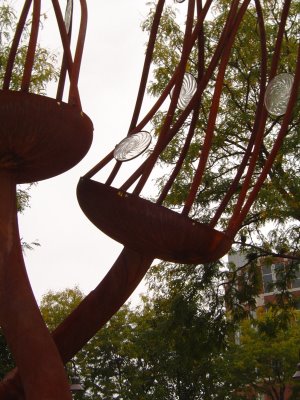
As long time listeners of this blog know, I've been tracking the Lincoln Park Community Art Initiative's annual public sculptural exhibit for a while. To the right are two shots that I took of the heavy-duty piece that's camped out for the year (and possibly longer, read on) at the northwest corner of the intersection of Halsted, Fullerton, & Lincoln called Chicago WhatKnot.

The shimmery disks are a lovely surprise when the sun hits them right, and I like that it has an underwatery feel. I also like how the weight and size of the sculpture contrast so sharply with floral life, like urban flora, yet it fits right in.

I'm especially pleased and honored that the artist, Chicagoan Nicole Beck, was kind enough to share some thoughts about the piece via e-mail. Be sure to visit her website if for no other reason than to see her personal photo on the contact page. It's quite possibly the coolest shot ever of an artist.

Nicole Beck on her sculpture, Chicago WhatKnot:

Chicago What Knot is 8' diameter x 20' steel and custom-cast glass rondeles. I built the piece entirely by myself, except for the steel tube rolling which was done at Chicago Rolled Metal (the same company the rolled the stainless tube arcs that traverse the lawn of Gehry's band shell lawn structure in Millenium Park.)

But as you can see by investigating the piece up close, I had to make some pretty specific miter cuts to reposition the graceful line that the tubing makes, and especially to fit the site (the tubing could not be rolled any tighter because it was at the limits of the equipment.)

The Alderman Vi Daley and her committee knew during judging for this year's show that they wanted the sculpture on this site, so I built the sculpture to be "site specific," to fit the dimensions and the scale of the site nicely.
The sculpture was created in response to the Art in the Gardens Project . . . that I did last summer in Grant Park on Michigan Ave. @ Balbo across from the Hilton. I had created a 40'x 100' living sculpture with plants as my medium.

Most of the gardens in this city-wide public art project were created to be looked at, but my project Snake Gourd Chamber Maze was designed to have a Celtic knot looped garden path that the viewer could walk through to experience the full beauty of the garden. . . .

Chicago WhatKnot was a response to Snake Gourd Chamber Maze in STEEL & GLASS! . . . For Chicago WhatKnot, the tendrils at top were created separately and bolted into place for ease of shipping and then the cast glass is installed on site into customized gaskets that also bolt into place.

I think of the cast glass discs as water droplets randomly interspersed throughout the tendrils sprays OR as stars in the sky seen through the bare tree limbs of winter.

This sculpture was a departure for me in that the lines are playful and lyrical and dance in space (alot of my other pieces are hard-edged and geometrical) see my web site.

There is talk of wanting to keep this piece permanent for the neighborhood, or perhaps rebuilding the piece in stainless steel (but will cost much more for this, as stainless is a VERY expensive material these days.)

But, I hope that the funds are collected as I personally believe that this piece belongs at this site and is no wonder, since it was specially designed specifically for this place.

I especially appreciate the night lighting with spots on the sculpture that make the discs glow and sparkle.

Thursday, November 03, 2005

The Children in the Box

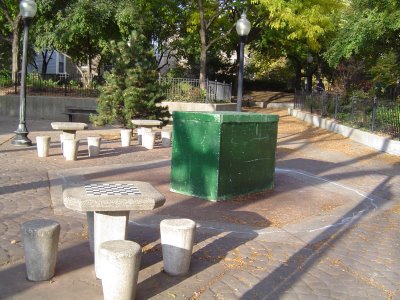
I almost choked when I came across this last weekend while walking Boomer through the Ogden Park mall near Hudson and Sedgwick.

Do ya think they could have thought about the weather implications before they chose a precious fountain that needed to be wrapped up all winter? What is the point of putting a fountain in a park if you have to look at this ugly box six months out of the year? Whose bright idea was this?

Obviously, a fountain can't run during the winter, but it can still look nice. No fountain at all would be nicer than this box half of the year.

The other thing that really gets me is that I hate this fountain. It's a little boy and girl depicted at scale. Each holds a saucer. She has birds on her shoulder and he has frogs in his pocket. God, it's enough to give me cavities just thinking about it.

But, what I double hate about it is that the two little kids are white. (Well, technically, I think they're bronze.) But, they're depictions of what white kids look like. Don't get me wrong. I have nothing against white kids. I have two of my own.

But, my point is that this is a public place and when you depict people, especially with public art, you've got to think about the implications of how others, not in the depiction, might feel about seeing that in what is also their public space.

What does this sculpture imply to children of color about whom the park is for? Particularly given the fact that it's located in a predominantly white neighborhood? If it was a statue of civic pride -- like a tribute to the two youngest botanists ever, okay, maybe I get it. But, thinking about things from several vantage points shouldn't be that rare when shaping our civic spaces.

And, now that you got me thinking about it, it's creepy. Two children frozen in a green box all winter long. That's so screwed up.