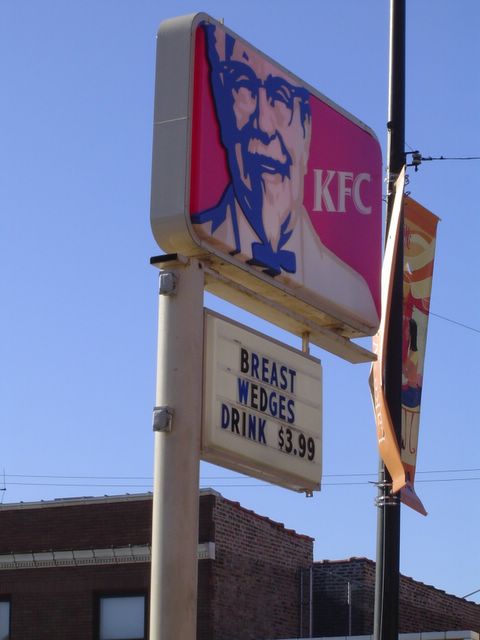
Okay, you must, at some point in your Chicago life, like tomorrow, stop by Blommer's Chocolate Outlet at the corner of Kinzie and Milwaukee. But, before you go, look below real closely. Back row. Third from the left. That's what you want. Don't leave the store without them.
Buildings, Trees, Sidewalks, Glue . . . . A Chicago, IL Blog Dispatched from the 43rd Ward on the Near North Side . . . Lincoln Park. 60614 . . . Blog in Urbs in Horto. Established 2004.
Saturday, February 12, 2005
Friday, February 11, 2005
Happy Birthday Weekend, Abe Lincoln!
Uncomfortable
since 1909 in that
tiny penny chair?
Or is the D.C.
memorial marble one
worse? Bet your back hurts.
Imagining Lincoln
I think one of the things that I find so remarkable about Abraham Lincoln’s Gettysburg Address is that whenever I read it, the goofy caricature images of him fade, and I begin, in my mind’s eye, to see a real man.
Here it is. Maybe you'll agree:
Four score and seven years ago our fathers brought forth, upon this continent, a new nation, conceived in liberty, and dedicated to the proposition that "all men are created equal"That’s just smoking prose. The cadence is so distinct. The words so thoughtfully strung together. It sounds as if he's right here visiting my blog.
Now we are engaged in a great civil war, testing whether that nation, or any nation so conceived, and so dedicated, can long endure. We are met on a great battle field of that war. We have come to dedicate a portion of it, as a final resting place for those who died here, that the nation might live. This we may, in all propriety do. But, in a larger sense, we can not dedicate -- we can not consecrate -- we can not hallow, this ground-- The brave men, living and dead, who struggled here, have hallowed it, far above our poor power to add or detract. The world will little note, nor long remember what we say here; while it can never forget what they did here.
It is rather for us, the living, we here be dedicated to the great task remaining before us -- that, from these honored dead we take increased devotion to that cause for which they here, gave the last full measure of devotion -- that we here highly resolve these dead shall not have died in vain; that the nation, shall have a new birth of freedom, and that government of the people by the people for the people, shall not perish from the earth.
If you’ve ever put finger to keyboard (or quill to parchment), you know that creating this kind of eloquence can be as elusive as attaining inner peace.
In his book Style: Toward Grace and Clarity, University of Chicago Emeritus Professor Joseph M. Williams writes about what makes Lincoln’s words so powerful:
Lincoln assigned responsibility to his audience. By consistently topicalizing we to make himself and his audience the agents of the crucial actions, Lincoln made them one with the founding fathers and with the men who fought and died at Gettysburg. By so doing, he tacitly invited his listeners to join their dead fore-fathers and their dead countrymen in making the great sacrifices the living had still to make to preserve the Union.Williams suggests that had Lincoln shifted the agency away from the people (i.e., the continent witnesses, a great civil war tests, the war creates), he would have "relieved his audience of their responsibility to act, and would thereby have deprived us of one of the great documents in our history."
Williams reminds us that Lincoln’s prose is every bit as rhetorically (and politically) relevant today as it was in November of 1863. No wonder we can picture Abe so well.
Thursday, February 10, 2005
Short but Sweet
To: ThePlaceWhereWeLive@yahoo.com
Subject: Re: Request for info from tootsie.com
Date: Tue, 8 Feb 2005 18:58:46 -0400
Tootsie Rolls, Frooties, Fruit Rolls, Tootsie Pops, Dots and Fluffy
Stuff Cotton Candy.
On Mon, 7 Feb 2005 23:03:25 -0500, ThePlaceWhereWeLive wrote
> Name................... Jennifer
> Title..................
> Organization...........
> Address................
> City................... Chicago
> State.................. IL
> Zip.................... 60614
> Phone..................
> Fax....................
> Email.................. ThePlaceWhereWeLive@yahoo.com
> Questions/Comments..... Hi,Can you please tell me which candies are
manufactured in Illinois. Thank you.
Wednesday, February 09, 2005
Buildings the Size of my Thumb
In yesterday's Chicago Tribune, Blair Kamin reported on the new American architecture postage stamps due out this year. The 12 featured buildings are:
- The Guggenheim Museum in New York City by Frank Lloyd Wright
- The Walt Disney Concert Hall in Los Angeles by Frank Gehry
- The Yale Art and Architecture Building in New Haven, CT by Paul Rudolph
- The Chrysler Building in New York City by William Van Alen
- The Lake Shore Apartments in Chicago by Mies van der Rohe
- The High Museum of Art in Atlanta by Richard Meier
- The Vanna Venturi house in Philadelphia by Robert Venturi
- The East Building of the National Gallery of Art in Washington, D.C. by I.M. Pei
- The Library at Phillips Exeter Academy in New Hampshire by Louis I. Kahn
- The TWA Terminal at the Kennedy Airport in New York City by Eero Saarinen
- The glass and steel house in New Canaan, CT by Philip Johnson
- The John Hancock Center in Chicago by architect Bruce Graham and engineer Fazlur Khan of Skidmore, Owens, and Merrill
I'm glad Kamin pointed out the east-coast bias of the choices, and I share his disappointment that Chicago got only two stamps. But, like Kamin, I agree that the series is, generally, all good.
I have one small quibble with Kamin's disappointment about the inclusion of Venturi's mother's house. I can't argue for its importance, but I was pleased to see something of this small scale (1800 square feet) included next to Johnson's glass house and among the giants.
The public face of "Architecture" sometimes overwhelms. I frequently find it easier, as an armchair critic, to engage with smaller works in order to realize ideas about larger ones. If one benefit of the stamps is to increase the public's appreciation of architecture, then including a small second work was worthwhile -- even if a better choice could be found.
Tuesday, February 08, 2005
Buzznet Chicago
Caution: Falling Facades
"With the facades, we really get no warning," said (Preservation Chicago Vice President Michael) Moran, who's pushing for more protection for the front sides of historic buildings. "One day they're there and the next day they're gone. No neighborhood review process, no zoning change applied for, no hearing, no nothing. And it's happening all over the city. . .
The 90-day reprieve allows city landmarks officials to decide whether to pursue last-minute hearings to save the building. But an old edifice with a new facade won't stand a chance, Moran said. And as long as they don't raze it altogether, property owners can strip an orange-rated building of its facade with no special permission.
"Whenever somebody says, 'This building has lost its historic architectural integrity' -- one of the criteria for landmarking -- that means that the facade has been changed," Moran said. "Developers know this . . . "
I'm sorry to see vintage facades ripped off and replaced. The loss diminishes the visual interest of a neighborhood and erases its links to the past.
Moran believes part of the problem is also that people don't have time to care about their neighborhood's facades.
"Altered facades are part of the drip-drip-drip of uglification," Moran said. "It's like, 'Yeah, they did that, but I'm busy with my life.' Facades don't spur people to action the way traffic problems do. It's a disease that doesn't quite stimulate the immune system and so it festers."I believe what Moran says, but I also think that if the preservationists framed their arguments differently, they might see people getting out of their armchairs to help. Who are "the developers"? It seems when preservationists discuss developers, they always refer to them as an indistinguishable group.
Who are the most indifferent developers? Who are the ones building thoughtfully in our communities? The lack of specificity of offenders, at least in this article, undermines their argument. They can't all be bad. Or can they?
Imagine if the preservationists named the ten most egregious developers, revealed their profit margins, and published photographs of their giant Lake Forest houses. They would draw out the tensions between developer and neighbor more specifically, and they might discover that people would indeed be spurred into action.
At the very least, the developer stigmas could stick and they might be pressured to change rather than lose prospective buyers. Then preservationists could focus their meager resources on fighting the biggest offenders and promoting the most conscientious. They may even save some more facades along the way.
One side note: I have yet to read George Lakoff's book, Don't Think of an Elephant: Know Your Values, Frame the Debate. So, my reference here to frames is uninformed by his arguments on the subject.
Monday, February 07, 2005
Out with Orange, In with Dots
In case you didn't know, according to the February 6 Chicago Tribune, polka dots are in. The Trib quotes "trend guru" Michelle Lamb, publisher of The Trend Curve newsletter, who stated, "As consumers look for some sort of whimsy to use for stress relief and to balance the increasingly serious world outside, dots fill the bill without going over the top.'"
She did not discuss the status of orange. .
- Straight Dope on the origin of the term "polka dots"
- How to Polka
- Beer Barrel Polka lyrics
- Douglas Bowman of Stopdesign created this template for Blogger. Thanks, Douglas!
Sunday, February 06, 2005
Found Money
Friday, February 04, 2005
Copyrighting of Public Spaces
I think a related issue is the diminishing numbers of public and commercially-owned places that refuse to allow flyers to be posted on their premises. Got a rock band? A fundraising event? The number of public and public-like spaces where you can distribute your information is limited.
Libraries have bulletin boards for this information, but their size and location vary among branches. Many shopping malls don't allow leaflets from the public. Starbucks prohibits any materials from being left in its stores. Barnes & Noble used to allow flyers in their lobbies, but no longer. Same with Borders.
Last year, I tried to post flyers for a non-profit event at a Starbucks. I was told "no." I wanted to drop off copies of an independent newspaper at Borders. They said "no." Both times, the employees felt really bad about turning me away. Their common sense and presence in the community told them this was no biggie. But, corporate policy overrode them. Would corporations benefit if they began thinking of customers as their stores' neighbors rather than as consumers?
I understand that the Millennium Park issue is a true tax-supported public space and not a commercially-owned space like I'm (mainly) complaining about. For this, I think the copyright issue is especially egregious. But, more and more often, commercial spaces function like public spaces. And, by looking at the flyer issue we can see in a subtle way how locally-owned coffee shops and bookstores function differently in our neighborhoods.
Because I don't have any independent bookstores or coffee shops in my neighborhood, I ended up posting my flyer and distributing my newspaper at my local YMCA (a non-profit organization.) They have a giant bulletin board in the women's locker room for flyers, and they provide a space for independent newspapers. Could their attitude have anything to do with their mission statement: "We build strong kids, strong families, strong communities"?
From the File Marked "Unfortunate Buildings"
This building on Division, just east of Milwaukee, is a) ugly and b) completely inappropriate in scale given the smaller buildings surrounding it. They've begun repairing the concrete and painting the east side of it, but it's not helping much. The two good things are 1) the people living in the building's south side will get a lot of sun and 2) it took me a while to notice it.
Thursday, February 03, 2005
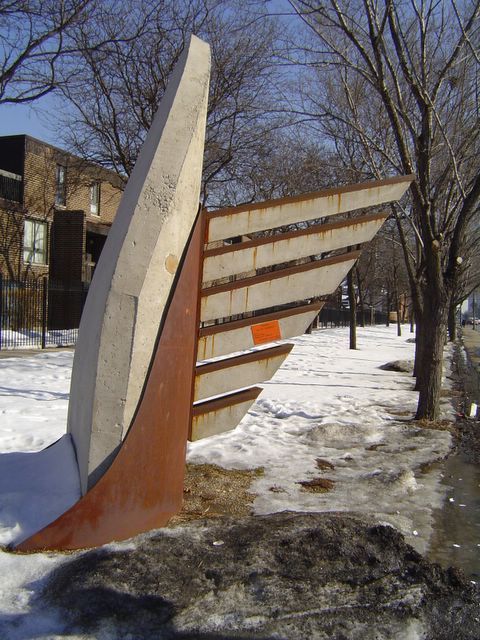
"Tundra" Around the Corner
"Tundra," View 1
This sculpture is titled “Tundra.” It sits on the northeast corner of North Avenue and Orchard Street. I drive by it every day. At first I thought it looked like a giant, ugly iron with a rusty tail fin. Eventually, I sort of began to appreciate the contrast between its seeming aerodynamics and its sense of great weight. Then, one day I was walking my dog and I saw it from this angle:
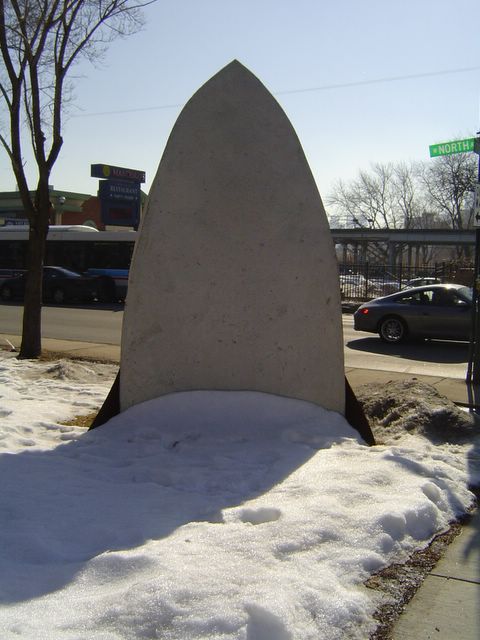
"Tundra," View 2
From here, it felt like the iron could flatten me at any moment, but I didn’t care so much because I was having fun enjoying its sharkness.
The piece, by Pat McDonald, was a winner in the 3rd annual Lincoln Park Sculpture Competition. Launched by my alderman Vi Daley and the Lincoln Park Community Art Initiative, the competition selects ten artists every year to display their work in our neighborhood.
Even if the sculptures aren’t always successful, they beat back the monotony, surprise the eye, and engage us in new ways as we mush along sidewalks or brake through traffic. Plus, just when we might be getting tired of them, ten new ones show up. Our next round of public art is expected in May.
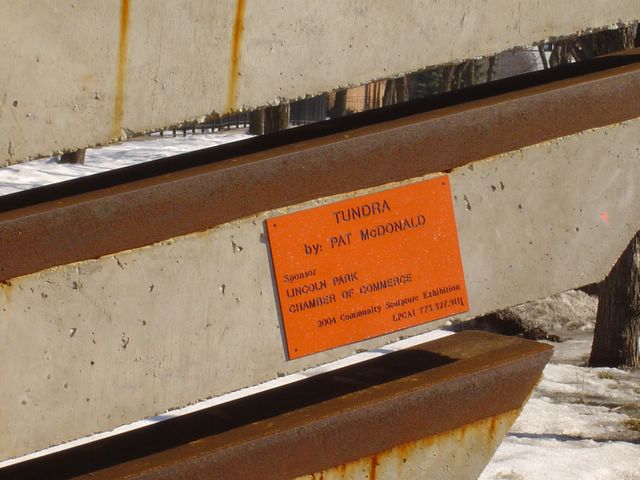
"Tundra," View 3
Side note: I used to think the giant orange rectangle on the fin was a lost dog flyer that someone hastily posted on the sculpture. But, upon closer inspection, it’s the artist’s name and title of work plaque! From afar, it looks like mild vandalism. It immediately draws the eye and distracts fromthe piece. What was the art committee thinking by pasting it to the middle of the sculpture?
Wednesday, February 02, 2005
Sidewalk Talk
Tuesday, February 01, 2005
CPL Fires up Free Hot Spots
Free wireless access might seem to you like a modest city improvement, but it matters. As you can tell from the folks hanging out at your local Starbucks, we need more places not fewer where we can fill our minds or empty them out. Libraries have long been the traditional spaces to do that, and now they're ramped up and ready to go for the 21st Century. The funny thing is we'll probably end up checking out more books.
Saturday, January 29, 2005
Hey ladies, BOW!
Okay, one more discovery to share with you from my poking around the State of Illinois website. Then, I've got to do laundry and pay bills.
Ladies! You can Become an Outdoors-Woman thanks to the Illinois Deparment of Natural Resources and a non-profit group, BOW.
The Become a City Woman program (BOCW), with skills like how to get your table moved deeper into the non-smoking section, who's your alderman, and where to buy a good donut, has yet to be developed.
A Deeper Shade of Blue, Part Two
First Illinois committed to protecting gay people from discrimination. Now, they've made it illegal for health insurance companies to charge women for birth control pills. God, I love this state.
Whadda you say we wait seven days, and if we aren't all mingling in hell by then, the right wingers call it a day?
Update: I had this wrong. Insurance companies must cover the pills, but they may charge something for them. At least I had the seven days part right. Be gone with you right wingers!
Friday, January 28, 2005
You'll Never be Stirred to Greatness Here
Yesterday I went to the Harold Washington Library for the first time in a long while and was reminded that the building is like a dunce's paper bag. You can't find your way out of it. Or, into it for that matter.
They shaped the main lobby like a giant cube. Four corridors depart off of it, but not one architectural detail suggests where the hallways lead. Left-over street banners and other paper afterthoughts sag from the walls. In the center of the lobby the architects created a circular opening in the floor that lets you gaze one whole storey below. The main level also houses the "Popular Library." I think this is where you'll find the Danielle Steel novels and the cool high school kids, but I may be wrong about that. Perhaps it's where they put the Starbucks.
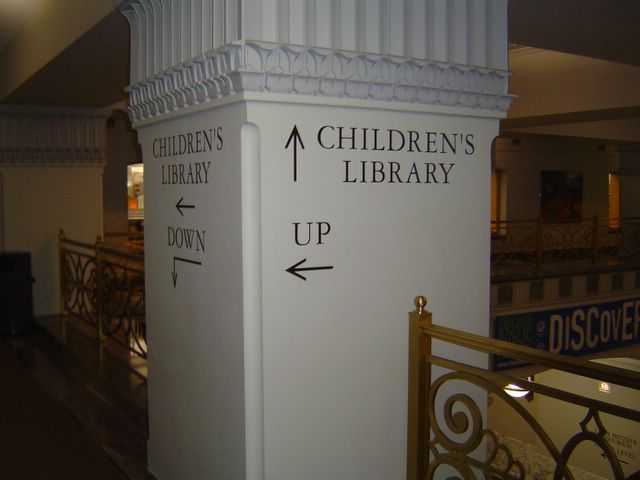
The architects hid the unpopular library two escalators up, around a few corners, and through an undistinguished entry-way. Signs with giant letters and arrows shout from the gray walls. They seem to trying to make up for the work the architecture failed to do. Their bland tyepface drains the warmth from the atmosphere that the wood paneling and retro-lamps struggle to provide.
The architects tried to breathe some life into the place by stencilling quotations from Big Thinkers on the walls, but they failed miserably. You'll never be stirred to greatness here. You'll never feel inspired to invent a flying machine or pen a novel based on Proust's Remembrance of Things Past. Frankly, you'd be lucky to find the books you want.
The library makes almost no effort to help patrons figure out what floors house which books. When I told a reference librarian that I was having a hard time finding the call number locations for the titles I needed, she laughed and said, "Tell me about it. We should really have those posted somewhere." Then she reached for a thin black binder where she kept the secret information. My six books were located on four different floors.
Even the library's website takes pains to distance itself from the creation:
The architect responsible for the design is Thomas H. Beeby and his colleagues in the firm Hammond, Beeby and Babka. It was their design as a part of the Sebus Group that won a design/build competition in June of 1988.
In other words, we're not responsible. We love libraries. Beeby's the one who hates them.
Thursday, January 27, 2005
When You're With a Sweep . . .
Flyers on Your Windshield
Wednesday, January 26, 2005
Then & Now: 1327 N. Noble
Sunday, January 23, 2005
Chicago's Finest (No Irony Intended)
"Many men of the Sikh faith wear a small sword under their clothing. Orthodox Jews often refuse to move illegally parked cars on Saturdays. Outsiders may photograph statues in Buddhist temples, but not in Hindu ones.
These are some of the insights in a series of videos the Chicago Police Department uses to train its officers in dealing with non-Christians. Community leaders say the videos have substantially improved relations between various religious groups and police officers.
'This is not just a superficial thing,' said Kareem M. Irfan, chairman of the Council of Islamic Organizations of Greater Chicago. 'It has changed our community's relationship with the police to the extent that people are beginning to see the Chicago Police Department as an ally rather than an opposing force.'"
From The New York Times, January 23, 2005
Keep DREAMING BIG!!!
Happy New year to everyone! I hope that 2005 is a year full of realized dreams and lots of success for all of you. December was not very busy for me as Miss Illinois, but still a fulfilling month between visiting friends and spending time with family for the holidays. . .
I was honored to be the emcee for an Essay, Poetry and Art contest awards event at Jones High School in Chicago on December 16. . . . I am very excited as these students give tangible evidence of the violence that the Miss Illinois Organization is taking a stand against.
On a lighter note, the weekend of December 10-12 was a small Miss America Reunion in Nashville, TN. A few of us met in Nashville hosted by Ashley Eicher, Miss Tennessee, and had a blast together. Thanks, Ashley! It was our first time to see each other after the Miss America competition in Atlantic City and so fun to hang out without any pressure of competition.
Thank you for your continued support.
Keep DREAMING BIG!!!!
E-mail me
at: missil04@yahoo.com
Love,
Michelle
http://www.missil.org/files/ILAUTOPADS.jpg
Saturday, January 22, 2005
A Deeper Shade of Blue
Governor's press release
Friday, January 21, 2005
Not Made in Chicago
The clothes I put on this morning and where they came from:
- Blue wool sweater. Made in Hong Kong. Bought at Saks Fifth Avenue (on clearance).
- Gray v-neck cotton t-shirt. Label missing. Origin unknown.
- White bra. Made in Indonesia. Bought at Target. (It pains me to tell you that.)
- Rust corduroy pants. Made in Cambodia. Bought at Old Navy.
- Underwear. Made in Israel. Bought at Victoria's Secret.
- Blue cotton socks. Origin unknown.
- Brown snow boots. Made in China. Bought from Lands' End.
Thursday, January 20, 2005
Splitting Food Hairs with Ira Glass, Continued
If you look around, you'll know I'm in no way ready for a visit from the big-time likes of him. I've got draperies to hang, boxes to unpack, and I can't decide what color to paint the rec room. Long ago I realized with my real house that if I waited until it was immaculately clean to have people over, I'd end up dying alone in an unmade bed. So be it with my blog. Come on in, Ira. It's my honor. The place is a mess, but go ahead and make yourself at home.
It seems Ira got word that I was niggling over some nuances of a review he wrote in the Reader (January 15 blog entry).
He dropped in to clarify:
I meant "neighborhood restaurant" as something connoting a sense of size and scale. Reasonable prices. Everyday eating. Versus, say, a tourist restaurant or a fancy businessman's restaurant.I get this. To the list of neighborhood restaurant features, I'd add dedicated personnel who seem integral to the enjoyment of the place. I'm thinking here of the ubiquitous, gracious owner of Aladdin Falafel House on Lincoln Avenue. Or, the warm owner of Think who daydreamed about putting a nursery downstairs so parents could enjoy dinner while she cared for their kids. Or, the host of Club Lago who kissed his two fingers and waved them at us as we left -- "See youse!"
At neighborhood restaurants, great food and great people blur. Choosing the best, I still think, is a bit like choosing a favorite relative. But, Ira deserves a break here. It was a 300-word restaurant review, not an urban studies thesis.
Coming Soon: Part 2 - Quibbling over the Importance of "New York"
Tuesday, January 18, 2005
Saturday, January 15, 2005
Splitting Food Hairs with Ira Glass
But two things in his review struck me.
First, he writes: "I don't say this lightly: it may be the best neighborhood restaurant in Chicago."
I don't think you can say a neighborhood restaurant is the best in Chicago any more than you can say Pilsen is better than Andersonville. Maybe he means "best restaurant located in a neighborhood." But the adjective where he's placed it suggests to me that the restaurant is particularly representative of the neighborhood somehow. That's hard to find and do. And, I don't think that's what Lula Cafe is, as splendid as it is.
Second, he writes: "I brought a friend who's a professional chef in New York, and he stuck around for hours to order nearly everything on the menu. "
Why use the qualifier "in New York"? It has an unfortunate whiff of cultural one-upsmanship. I'd like to think his including it was a grammatical reflex rather than a hint of the spoils of fame.
For the record: a) I don't know Ira Glass; b) I really love and admire This American Life; c) I suspect everything tastes different on the radio.